Business Travel Costs in 2026: What a Trip Actually Runs
A line-by-line look at business travel costs in 2026: airfare, lodging, ground transport, meals, and the change fees, bag fees and admin hours that never make it into the budget.
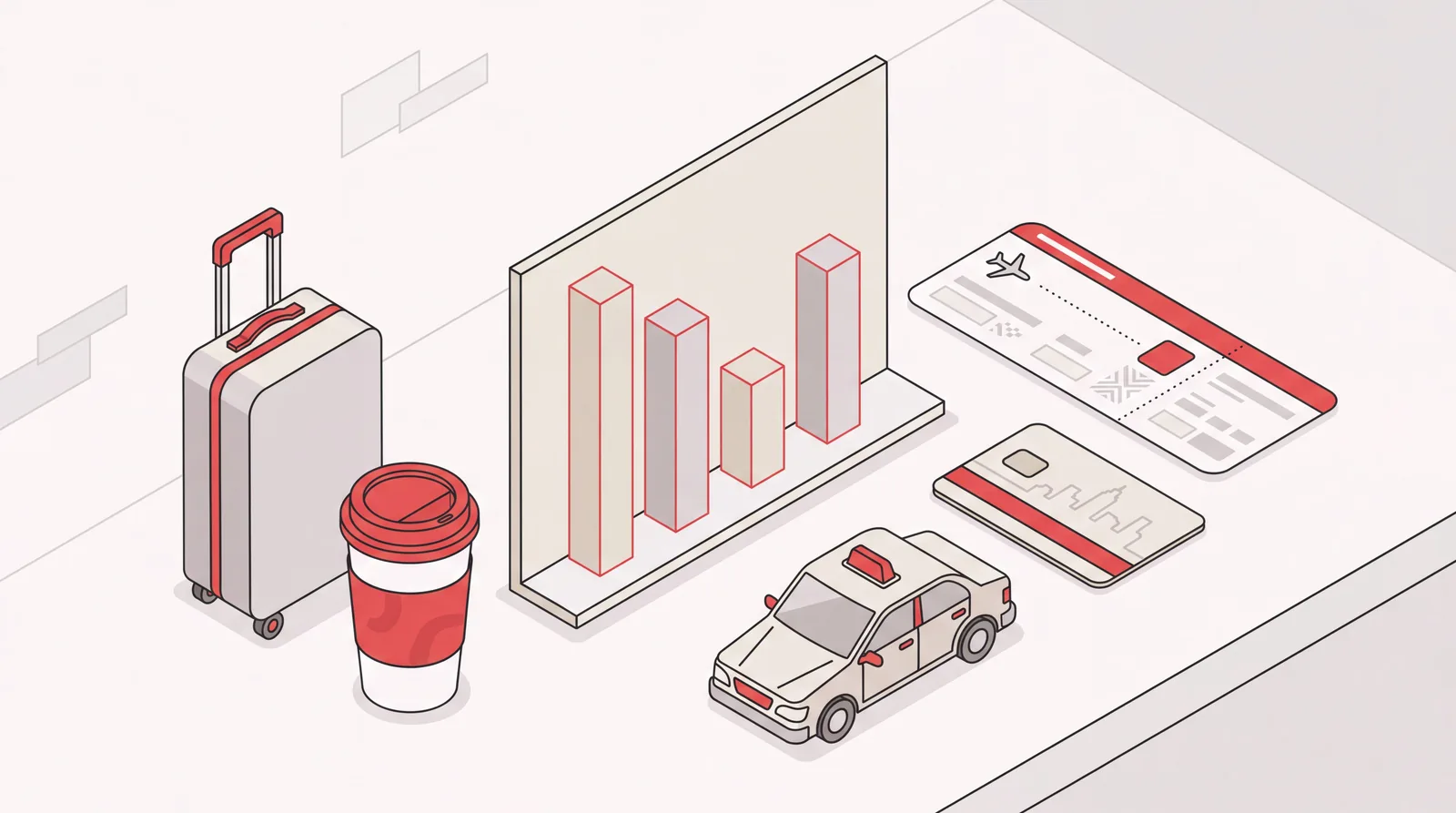
On this page
- What a business trip actually costs in 2026
- Airfare: the biggest swing factor
- Lodging: the biggest line item
- Ground transport
- Meals and incidentals
- The costs people leave out of the budget
- Change fees and the fare difference
- Cancellations and no-show nights
- Bags, seats, and the rest of the airline menu
- The late-booking premium
- The line item nobody budgets: the hours spent arranging it
- Where business travel costs actually leak
- How Catch handles the trip
- Frequently Asked Questions
Somebody asks what the Chicago trip is going to cost. You say two thousand. Three weeks later the card statement reads twenty-eight hundred, and none of the extra eight hundred came from anywhere dramatic. A fare that moved between the quote and the booking. A hotel that was the only one left within walking distance. Two flight changes, because the Thursday meeting slid to Friday.
I’m Nir Sabato, co-founder of Catch. Most of my week goes on conversations with executives and business owners about the admin eating their time, and business travel costs come up more than any other topic. Those conversations tend to land in the same place: the big items are the easy ones to estimate, and they are not where the budget breaks.
What follows is a breakdown of business travel costs in 2026, built the way you’d build a real budget. Published numbers where they exist, honest ranges where they don’t, and a proper accounting of the costs that never make it into an expense category at all.
What a business trip actually costs in 2026
Two anchors are worth having, and they answer different questions.
First, the federal per diem, which tells you what a disciplined, policy-capped trip is supposed to cost. For fiscal year 2026, running through 30 September 2026, the GSA standard CONUS rate is $178 a day: $110 for lodging and $68 for meals and incidentals. From 1 October 2026 the FY2027 standard rate rises to $181, with lodging at $113 and meals holding at $68. Those are the floors. GSA also sets higher rates in 295 designated non-standard areas for FY2027, and in the expensive markets the combined figure runs several times the standard.
Second, what the market is actually charging. The GBTA and ALTOUR forecast published in July 2026 puts the 2026 global average hotel rate at $168 a night, up 3.7%, and the average car rental at $46.50 a day, up 3.6%. CoStar recorded a US hotel average daily rate of $171.74 in July 2026, up 5.7% year over year.
Put the two together for a standard three-night domestic trip and a working range falls out:
| Line item | Conservative (policy-capped) | Realistic (major US market) |
|---|---|---|
| Airfare, round trip | $350 | $550 to $800 |
| Lodging, 3 nights | $330 | $520 to $900 |
| Ground transport | $120 | $200 to $350 |
| Meals and incidentals, 4 days | $238 | $280 to $400 |
| Airline extras and fees | $0 | $90 to $200 |
| Trip total | about $1,040 | $1,640 to $2,650 |
The conservative column is a trip booked three weeks out, in a mid-tier market, inside a policy people actually follow. The realistic column is New York, San Francisco or Boston during a busy week, booked eight days out. Neither one is an unusual trip. What separates them is timing and geography, not extravagance: nobody in the second column is booking anything lavish.
Airfare: the biggest swing factor
Airfare is rarely the largest line item. It has the widest variance, though, and that is what makes it the estimate-wrecker.
The Bureau of Transportation Statistics put the average US domestic air fare at $428 in the first quarter of 2026, up 4.7% from the fourth quarter of 2025 and the highest first quarter on record. Globally, GBTA forecast an average economy fare of $536 for 2026, an 8.7% rise, with premium cabins averaging $4,488.
In practice, three things move that number:
- How far out you book. The biggest lever you have, and pulling it costs nothing. Domestic fares are generally at their best somewhere in the two to six weeks before departure. Inside ten days they climb steeply. Inside three days they stop resembling the earlier price at all.
- Cabin and fare class. Basic economy looks like a saving right up until the trip changes. More on that below.
- Route competition. A route with three carriers and a route with one carrier price differently no matter when you book.
If your company caps fares, check what the cap is written against: the fare, or the cabin. On transcontinental routes those two produce very different bills.
Lodging: the biggest line item
On most domestic trips, lodging is the largest single category. Three nights at $175 is $525 before taxes, and hotel taxes in US cities commonly add 12% to 17%, sometimes more once occupancy and tourism levies stack up. Resort or destination fees turn up on business hotels more often than you’d expect, at $25 to $45 a night.
The expensive mistake here isn’t the nightly rate. It’s booking by city instead of by address. A hotel $40 a night cheaper but twenty-five minutes from where the meetings actually happen costs more once you add four taxi rides and the risk of walking in late to the meeting the whole trip exists for. Book against the address of your first meeting and let the rate fall where it falls.
Two smaller lodging costs worth a line in the budget:
- The arrival-night problem. A 7:00 a.m. Tuesday meeting in another time zone usually means a Monday night room. That night belongs in the trip budget even though no meeting happens on it.
- Late checkout. An evening flight home and an 11:00 a.m. checkout leave you with six hours and a suitcase. Ask the front desk early and it’s often free. If nobody asks, it’s $50 to $100, or a day-rate lounge when the hotel says no.
Ground transport
Ground is the category people round to zero and then quietly spend $300 on.
GBTA forecast the 2026 global average car rental at $46.50 a day, before fuel, insurance and airport concession fees, which routinely add 25% to 35% to the base rate. For most single-city trips a rental is the wrong tool anyway. Rideshare between the airport, the hotel and two or three meetings usually runs $150 to $300 across a three-day domestic trip, more in cities with a long haul from the airport.
When someone drives their own car, the IRS sets the reimbursement rate. The 2026 business standard mileage rate was 72.5 cents a mile through 30 June, then rose to 76 cents from 1 July through the end of the year. A 180-mile round trip to a client site works out to about $137 at the second-half rate.
Airport parking is the one everyone forgets. Long-term parking at a major US airport runs $15 to $30 a day, so four days of it costs roughly what two rideshares each way would.
Meals and incidentals
The per diem framework makes this category easy to budget and hard to overspend, which is why plenty of companies use it despite not being federal agencies.
The FY2026 standard M&IE rate is $68 a day: $16 for breakfast, $19 for lunch, $28 for dinner and $5 of incidentals. Non-standard areas run from $68 up to $92. First and last travel days reimburse at 75%, which is $51 on the standard rate. So a four-day trip on the standard rate budgets at $51 + $68 + $68 + $51, or $238.
Reality intrudes when there’s a client dinner. One of those in a major market clears the daily rate on its own. If client entertainment is part of the trip, give it its own line rather than hoping the per diem absorbs it.
The costs people leave out of the budget
This is where estimates go wrong, and it is rarely one large surprise. It is usually four small ones that all land on the same trip.
Change fees and the fare difference
Most US carriers dropped change fees on main cabin and above. American, Delta, United, Alaska and JetBlue will move you without a fee, and you pay the fare difference. That difference is the real cost, and it’s seldom small: rebooking a flight eleven days out into a flight two days out means paying the two-day price.
Basic economy is where this bites hardest. On most carriers it can’t be changed at all after the first 24 hours, so a schedule shift means buying a new ticket, with a travel credit for the old one at best and nothing at all on some carriers. The $60 you saved on the fare turns into a second full-price ticket. Match the fare class to how firm the trip really is.
One rule holds everywhere: the Department of Transportation requires airlines to give a full refund to the original form of payment if you cancel within 24 hours of booking and the departure is at least seven days out. Every carrier, every fare class. If a trip is 90% certain, book it and spend the 24-hour window confirming the remaining 10%.
Cancellations and no-show nights
Hotel cancellation windows have tightened. Forty-eight and seventy-two hour policies are common now in busy markets, and missing the window costs a night, occasionally the whole stay on prepaid rates. On a $250 room, that’s a $250 line item created by nobody noticing a deadline.
Bags, seats, and the rest of the airline menu
Checked bag fees rose across the major US carriers in April 2026. A first checked bag now runs roughly $40 to $45 each way on the big three, and the second bag costs more. Add seat selection at $15 to $60 a leg, plus inflight wifi, and a $428 fare is a $560 trip before anyone has left the airport. Send four people to the same conference and it’s real money.
The late-booking premium
Every category above has a late version that costs more. The fare, the room, the aisle seat, the airport transfer during a conference week. Nobody is charging a penalty on purpose; it’s simply what’s left once the cheap inventory is gone. And of all the cost drivers here, it’s the one sitting entirely within your control that almost nobody manages, because trips are usually known about weeks before anyone books them.
The line item nobody budgets: the hours spent arranging it
Every trip eats somebody’s working hours. Comparing fares, holding the hotel, confirming meeting addresses, sorting ground transport, rebuilding half of it when a meeting moves, chasing the confirmation that never arrived. That time costs money, and it belongs in the trip budget.
I won’t hand you a statistic on how many hours it takes, because it depends entirely on the trip and the person. You can work out your own number in about a minute, though, and it’s worth doing once.
- Count the hours for one real trip. Not an estimate. Take a trip that actually happened and add up the booking time, the rebooking time, the confirmation chasing and the itinerary building. Include the interruptions. They’re the expensive part.
- Price the hour. Divide the salary by 2,080 working hours, then add a quarter or so for benefits and payroll costs. Someone on $150,000 is about $72 an hour before loading and roughly $90 after. Someone on $250,000 is about $120 before and roughly $150 after. Use whoever is actually doing the arranging.
- Multiply, then multiply again by your trip volume. Four hours at $150 is $600 on one trip. Fifteen trips a year is $9,000, sitting on a cost line that appears in no expense report.
Two things usually fall out of that arithmetic. On a $1,600 trip, the arranging is a material percentage of the total rather than a rounding error. And the hours are almost always spent by the most expensive person available, because the executive knows their own constraints and nobody else does.
That second one is the actual problem. Booking a trip isn’t hard. The difficulty is that the context required to book it well sits in one person’s head and calendar: which meeting anchors the dates, which hotel is walkable from it, which airline they hold status with, which return flight leaves enough margin after the last meeting.
Where business travel costs actually leak
If you go looking for money in your travel spend, four leaks account for most of it. Roughly in order of size: the gap between knowing about a trip and booking it, trips booked in the wrong fare class for how certain they are, hotels chosen by city instead of by meeting address, and the last mile of late checkouts and transfers that costs nothing to arrange in advance and plenty to sort out at the counter.
All four are timing and attention problems rather than pricing problems, which is precisely the part a negotiated rate program can’t fix.
How Catch handles the trip
Catch is an AI executive assistant, and business travel is one of the things it takes off your plate completely. It isn’t a booking site you search. It does the booking, and it works the way a good executive assistant works: it notices the trip before you ask.
Catch reads your calendar and email and spots the trigger. A conference ticket in the inbox with no flight against it. A face-to-face meeting in another city. A hotel booked with free cancellation and nothing else around it. From there it proposes the flight and the hotel, books them end to end, and keeps managing the trip afterwards.
Against the cost lines above:
- It closes the knowing-to-booking gap, the largest single source of overspend. The trip gets booked when it becomes known, not when someone finally finds an hour.
- It books by context rather than by city. A hotel within a ten-minute walk of the actual meeting address, a return flight that leaves real margin after your last meeting.
- It books inside your company’s travel policy where one exists: rates, caps and authorized upgrades. Catch respects the policy. It isn’t a spend-control console sold to your finance team, and it doesn’t handle expense reports, receipts or reimbursement today, so that side of things stays wherever it lives now.
- It keeps watching after booking. It scans for better rates and will cancel and rebook when it finds one.
- It handles the last mile, including the parts that need a phone call. Catch places real outbound calls to confirm early check-in or late checkout, book the restaurant, or check that the room has what you need. It identifies itself as an AI on those calls.
- It learns your preferences over time: airline, seat, flight times, hotel chains, room type. The second trip takes less input than the first.
Business travel suits an agent for a specific reason. It repeats, and the objective is fixed. Same executive, same conference, same city, known dates, a known policy. Leisure travel is the opposite, with open-ended dates, open-ended destinations and personal taste, which makes it a poor thing to hand off in a chat. That repetition and that fixed objective are why Catch books business travel only, and not leisure or personal trips.
Pricing is flat at $99 a month. No credits, no usage tiers, no per-call fees, and phone calls are included. On security, Catch is SOC 2 Type II certified, holds CASA Tier 2 as a Google Verified App, and hosts data in the US.
Market rates are outside your control. What you can change is when a trip gets booked, how well it matches the actual meetings, and who spends their afternoon arranging it.
Frequently Asked Questions
What is the average cost of a business trip in 2026?
A three-night US domestic business trip usually lands between $1,000 and $2,700, depending on the market and how far ahead it was booked. A policy-capped trip in a mid-tier city sits near the bottom of that range. A major-market trip booked inside ten days sits near the top.
What are the main categories of business travel costs?
Airfare, lodging, ground transport, and meals and incidentals cover most of it, and lodging is usually the largest single line on domestic trips. Airline extras, change fees and the hours spent arranging the trip fall outside those four, and those are the ones budgets routinely miss.
What is the standard per diem rate for 2026?
The GSA standard CONUS rate for fiscal year 2026 is $178 a day: $110 for lodging and $68 for meals and incidental expenses. From 1 October 2026 it rises to $181 a day, with lodging at $113 and meals holding at $68. Higher rates apply in the designated non-standard areas.
How much is airfare for business travel in 2026?
The Bureau of Transportation Statistics recorded an average US domestic fare of $428 in the first quarter of 2026, the highest first quarter on record. GBTA forecast a global average economy fare of $536 for the year, with premium cabins averaging $4,488.
How far in advance should business trips be booked?
For domestic travel, roughly two to six weeks out is where fares are generally most reasonable. The bigger point: most trips are known about well before anyone books them, and closing that gap saves more than any other single action available to a company whose people travel regularly.
Do airlines still charge change fees?
Most major US carriers dropped change fees on main cabin and above, so on American, Delta, United, Alaska and JetBlue you pay only the fare difference. Basic economy generally can’t be changed at all after the first 24 hours, which makes it a poor choice for any trip that might move.
Can I cancel a flight for free?
The Department of Transportation requires a full refund to your original payment method if you cancel within 24 hours of booking, provided departure is at least seven days away. That applies to every US airline and every fare class, basic economy included.
What is the mileage reimbursement rate for 2026?
The IRS business standard mileage rate was 72.5 cents a mile from 1 January through 30 June 2026, then rose to 76 cents from 1 July through 31 December. Higher fuel costs drove the mid-year increase.
How do you budget for the time spent arranging business travel?
Count the hours on one real trip, rebooking and confirmation-chasing included, then multiply by the hourly cost of whoever does the arranging. A $150,000 salary works out near $72 an hour across 2,080 hours, closer to $90 once benefits and payroll costs are loaded in, so four hours of arranging is roughly a $360 line nobody records.
How does Catch reduce business travel costs?
Catch books trips as soon as it spots them in your calendar and email, which removes the late-booking premium behind most travel overspend. It books inside your company’s policy, picks hotels by meeting address rather than by city, and keeps scanning for better rates after booking. It does not handle expense reports or reimbursement today.
Keep reading
Related posts
What a Great Executive Assistant Does for Business Travel
What separates an executive assistant who books a trip from one who runs it: anticipating the conflict, holding preferences, handling the 11pm cancellation, and protecting the day after a red-eye.
How to Book Business Travel: The 2026 Guide for Whoever Does It
A guide to booking business travel in the order you actually book it: fare types, hotel rate and cancellation terms, ground transport, approvals, and the records finance needs.
How to Plan a Business Trip in 2026: A Step-by-Step Guide
A business trip plan is a set of decisions, not a booking session. Here is how to settle the purpose, the dates, the people, the policy and the fallback before anything is reserved.